
10 Best Voltage Testers for Every DIY Enthusiast – Reviewed and Ranked

If you’re a DIY enthusiast, choosing the right voltage tester is essential for safe electrical work. The KAIWEETS Non-Contact Voltage Tester and Klein Tools NCVT1P are great for basic tasks, while the Klein Tools Electrical Test Kit offers advanced features for serious projects. Models like the AstroAI Digital Multimeter provide versatility with user-friendly designs. Pay attention to safety ratings, ergonomics, and battery life when making your choice. Stick around to discover the best options on our list!
Key Takeaways
- Voltage testers vary in detection ranges; select one that matches your voltage needs, with options from 12V to 1000V available.
- Safety ratings, particularly CAT ratings, ensure protection against electric shock; choose testers with CAT IV ratings for maximum safety.
- Ergonomic designs enhance usability; features like backlit displays, pocket clips, and built-in flashlights improve ease of use in diverse conditions.
- Regular battery maintenance and auto shutoff features can extend the life of your voltage tester, making it more reliable for on-demand use.
- Pricing ranges from basic models around $10 to advanced ones over $50; balance affordability with quality for effective performance and safety.
KAIWEETS Non-Contact Voltage Tester

For DIY enthusiasts who prioritize safety and ease of use, the KAIWEETS Non-Contact Voltage Tester stands out with its ability to detect AC voltages ranging from 12V to 1000V without the need for direct contact. This handy tool features a bright LCD screen, buzzer alarm, and a compact design for portability. Its multiple alarms—sound and light—ensure you’re aware of high voltage situations. The integrated NCV probe simplifies detecting live or neutral wires, while the built-in flashlight helps in low-light conditions. Just remember, it’s wise to cross-check findings with a multimeter for accuracy. Enjoy safe and efficient testing!
Best For: DIY enthusiasts and electricians who need a reliable, non-contact tool for safely detecting AC voltage.
Pros:
- Compact and portable design with a pen hook for easy carrying.
- Multiple alarms (sound and light) enhance safety awareness during voltage detection.
- Built-in flashlight and intuitive feedback make it user-friendly in low-light conditions.
Cons:
- May yield false negatives, requiring cross-checking with a multimeter for accuracy.
- Some users reported issues with the device unexpectedly turning off.
- Limited to detecting AC voltage only, which may not meet all testing needs.
Klein Tools NCVT1P Non-Contact Voltage Tester Pen

The Klein Tools NCVT1P Non-Contact Voltage Tester Pen stands out as an essential tool for DIY enthusiasts who need quick and safe voltage detection. It detects AC voltage from 50V to 1000V, making it perfect for checking cables, circuit breakers, and fixtures. You’ll appreciate its non-contact feature, which lights up green when operational and red with a beep upon voltage detection. Its compact design includes a pocket clip for easy transport and offers 6.6-foot drop protection. Plus, with a CAT IV 1000V rating for safety and an auto power-off function, it conserves batteries effectively, ensuring it’s always ready when you need it.
Best For: DIY enthusiasts and professionals who require a reliable tool for quick and safe voltage detection.
Pros:
- Non-contact feature allows for safe voltage detection without direct contact.
- Compact design with pocket clip for easy portability and storage.
- Auto power-off function conserves battery life and enhances usability.
Cons:
- Limited to AC voltage detection; does not detect DC voltage.
- Requires batteries which may need periodic replacement.
- Detection range of 50V to 1000V may not suffice for specialized applications.
Klein Tools Electrical Test Kit with Digital Multimeter

Klein Tools Electrical Test Kit with Digital Multimeter stands out as an ideal choice for DIY enthusiasts who crave reliability and versatility in their tools. This kit includes the manual-ranging MM300 multimeter, a non-contact voltage tester (NCVT1P), and a receptacle tester (RT105). With the MM300, you can measure up to 600V AC/DC, 10A DC current, and 2MOhms resistance. The NCVT1P features an LED and audible tone for voltage detection, while the RT105 helps identify common wiring faults. Plus, necessary test leads and batteries are included, making this kit an essential addition to your toolkit.
Best For: DIY enthusiasts seeking a reliable and versatile electrical testing solution.
Pros:
- Comprehensive toolset that allows for multiple electrical measurements and fault detection.
- Includes essential accessories like test leads and batteries, ensuring immediate usability.
- Backed by over 160 years of experience from a reputable company known for quality craftsmanship.
Cons:
- Manual-ranging multimeter may require a learning curve for users unfamiliar with manual settings.
- Non-contact voltage tester may not detect all voltage types, potentially limiting its use in complex situations.
- Does not cover advanced wiring issues, focusing instead on basic fault detection.
Klein Tools Outlet Tester Kit with GFCI Tester and Voltage Test Pen

Ideal for DIY enthusiasts who want an extensive tool kit, the Klein Tools Outlet Tester Kit combines a GFCI tester with a non-contact voltage test pen. This high-performance kit helps you quickly identify common wiring issues in standard and GFCI receptacles. You can confirm the proper operation of ground fault protective devices in GFCI outlets with ease. The non-contact voltage tester detects voltage in cables, circuit breakers, lighting fixtures, and switches. With high-intensity LED indicators and a user-friendly ON/OFF power button, this kit makes electrical testing safe and efficient—perfect for any DIY project.
Best For: DIY enthusiasts seeking a comprehensive tool kit for efficient electrical testing at home.
Pros:
- High-performance kit includes both a GFCI tester and a non-contact voltage test pen.
- Quickly identifies wiring issues and confirms proper operation of GFCI outlets.
- User-friendly design with high-intensity LED indicators and convenient ON/OFF power button.
Cons:
- May not be suitable for professional electricians who require more advanced features.
- Limited to standard and GFCI receptacles, may not cover all electrical testing needs.
- Non-contact voltage detection may not always provide accurate readings in certain conditions.
AstroAI VTS Voltage Tester with Screwdriver

For DIY enthusiasts seeking a reliable and versatile tool, the AstroAI VTS Voltage Tester with Screwdriver stands out as an excellent choice. This integrated device offers a high-strength steel screwdriver at the tail, making it perfect for wire-checking and electrical projects. Its non-contact feature lets you measure AC voltage without any physical contact, distinguishing between live and neutral wires. With visual and audible alarms, dual sensitivity modes, and a user-friendly backlit screen, you’ll have all you need for accurate measurements. Lightweight and compact, it easily fits in your pocket, ensuring you can take it anywhere you tackle electrical tasks.
Best For: DIY enthusiasts and electricians seeking a versatile, portable tool for electrical projects and wire checking.
Pros:
- Integrated design combines a voltage tester and screwdriver for convenience in various tasks.
- Non-contact voltage detection ensures safety by measuring AC voltage without physical contact.
- User-friendly features like a backlit screen, flashlight, and adjustable sensitivity modes enhance usability in different environments.
Cons:
- Limited to AC voltage measurement, which may not meet the needs of those requiring DC voltage testing.
- Automatic shutdown feature may interrupt use if not carefully monitored during longer projects.
- Sensitivity adjustments might require some getting used to for accurate readings.
Voltage Tester Non-Contact Voltage Detector

When you need to guarantee electrical safety around your home or workshop, the Non-Contact Voltage Detector stands out as an essential tool for DIY enthusiasts and professionals alike. With three sensitivity settings, you can efficiently identify voltage levels from 12V to 1000V. This portable tester features a built-in flashlight for dark spaces, a buzzer that varies in sound for different voltage strengths, and a battery life alert. Whether you’re checking circuit breakers or outlets, its NCV technology assures safe and accurate detection, making it a reliable choice for any electrical project. You’ll appreciate its user-friendly design and functionality.
Best For: DIY enthusiasts, professional testers, and homeowners needing reliable electrical safety checks.
Pros:
- Portable design with a pocket-sized format and pen hook for easy carrying.
- NCV technology allows for safe and accurate voltage detection across a wide range of voltages.
- Built-in flashlight and detection light enhance usability in low-light conditions.
Cons:
- May have limited sensitivity for very low voltage readings below 12V.
- Requires battery replacement when voltage drops, which can be inconvenient.
- Automatic power-off feature may interrupt prolonged use if not monitored.
Klein Tools NCVT3P Dual Range Non Contact Voltage Tester

The Klein Tools NCVT3P Dual Range Non Contact Voltage Tester shines with its ability to detect voltages from 12 to 1000V AC, making it an essential tool for DIY enthusiasts tackling a wide range of electrical projects. With both visual and audible indicators, you’ll easily identify voltage presence. Its lightweight design and pocket clip allow for convenient storage and quick access. Need to see in the dark? The built-in flashlight has you covered. Featuring a CAT IV 1000V rating, it prioritizes your safety. Plus, the auto power-off function guarantees you won’t waste battery life during your essential tasks.
Best For: DIY enthusiasts and professionals seeking a reliable and user-friendly non-contact voltage tester for a variety of electrical projects.
Pros:
- Versatile voltage detection range from 12 to 1000V AC, suitable for multiple applications.
- Lightweight and compact design, complete with a pocket clip for easy portability.
- Safety features include CAT IV 1000V rating and green light indicator for no voltage presence.
Cons:
- May not be suitable for detecting low voltages below 12V AC.
- The built-in flashlight may not be as bright as standalone options.
- Auto power-off feature could be inconvenient for users who work for extended periods.
AstroAI Digital Multimeter Tester 2000 Counts
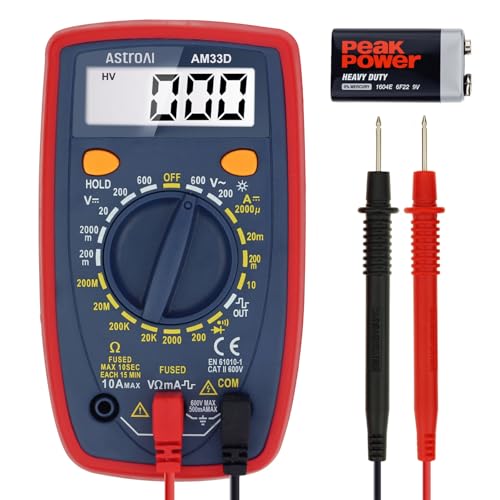
With its ability to measure AC/DC voltage, DC current, and resistance, the AstroAI Digital Multimeter Tester 2000 Counts stands out as an ideal tool for DIY enthusiasts tackling various electrical projects. This versatile device features a backlit LCD display, making it easy to read even in low light. You’ll appreciate its user-friendly functions, including data hold and auto shutoff, along with essential safety features like double fuses and anti-burn protection. It’s perfect for testing household outlets, batteries, and automotive circuits. Plus, with included support and a manual, you’ll have everything you need for accurate measurements on hand.
Best For: DIY enthusiasts and professionals looking for a reliable and versatile multimeter for electrical troubleshooting.
Pros:
- User-friendly features such as data hold, auto shutoff, and backlit LCD display enhance usability in various conditions.
- Safety protections including double fuses, anti-burn features, and a silicone cover provide peace of mind during operation.
- Versatile measurement capabilities enable testing of AC/DC voltage, DC current, resistance, and diode functionality for multiple applications.
Cons:
- Limited testing range as it cannot test all AC current and below 100mV AC voltage, which may restrict some applications.
- Sampling speed of only 2 times per second may not be fast enough for more complex measurements.
- Manual rotary switch requires users to ensure it is in the correct position, which may be cumbersome for some users.
Acv Detector 90-1000V

Designed for both DIY enthusiasts and professionals, the Acv Detector 90-1000V excels in identifying voltage presence in live circuits. With a detection range of 90 to 1000 V AC, this tool’s glowing red tip and audible beep signal voltage presence instantly. You’ll appreciate its reliability, boasting a CAT IV safety rating and continuous self-test indicators, ensuring safety in your electrical tasks. Users praise its accuracy, avoiding false readings, and its compact design makes it easy to store and use. Whether you’re a seasoned electrician or just starting, this device is a valuable addition to your toolkit, simplifying your electrical work markedly.
Best For: The Acv Detector 90-1000V is best for electricians, maintenance personnel, and DIY enthusiasts looking for a reliable tool to detect live circuits safely.
Pros:
- Accurate voltage detection with no false readings reported by users.
- Compact design for easy storage and transportation.
- High safety rating (CAT IV) with self-test indicators for reliable performance.
Cons:
- Limited to AC voltage detection (not suitable for DC).
- Some users may find the price higher compared to basic voltage testers.
- Requires regular battery checks to maintain functionality.
Klein Tools RT250KIT Non-Contact Voltage Tester and GFCI Receptacle Tester
If you’re a DIY enthusiast looking for a reliable and efficient tool for electrical work, the Klein Tools RT250KIT Non-Contact Voltage Tester and GFCI Receptacle Tester stands out as an excellent choice. This extensive kit includes the RT250 GFCI Receptacle Tester and the NCVT3P Non-Contact Voltage Tester, allowing you to detect AC voltage from 12 to 1000V. With a large backlit LCD display, you can easily read voltage levels and monitor GFCI trip times. The kit’s safety features identify common wiring faults, ensuring your electrical projects are safe and effective. Plus, the integrated flashlight adds convenience for dimly lit workspaces.
Best For: DIY enthusiasts and electricians seeking a versatile, safe, and user-friendly electrical testing kit.
Pros:
- Comprehensive kit including both a GFCI receptacle tester and a non-contact voltage tester.
- Large backlit LCD display for easy reading of voltage levels and GFCI trip times.
- Safety features that detect common wiring faults, enhancing electrical safety.
Cons:
- Non-contact voltage tester may not work as effectively through certain materials.
- The size of the carrying case may not be ideal for portability.
- Some users may find the learning curve for understanding all features a bit steep.
Factors to Consider When Choosing Voltage Testers
When you’re picking a voltage tester, it’s important to take into account several key factors to guarantee you make the right choice. Think about the voltage detection range, safety ratings, and how easy the tester is to use. You’ll also want to check the design and portability, along with the types of indicators it uses, so you can find the best fit for your needs.
Voltage Detection Range
How do you choose the right voltage tester for your needs? Start by considering the voltage detection range, which indicates the minimum and maximum voltages the tester can measure. You’ll find testers that span from as low as 12V to as high as 1000V AC. Some models even offer dual ranges, allowing you to switch sensitivities for different applications. Non-contact testers typically detect voltages from 50V and up, making them great for both household and professional tasks. It’s essential to select a tester that matches the voltage requirements of your projects, ensuring safe and accurate readings. An appropriate detection range minimizes the risk of mistakenly identifying live or non-live wires, helping you work safely.
Safety Ratings
Safety ratings are essential for guaranteeing you choose a voltage tester that can handle the demands of your specific tasks. Voltage testers come with different categories, known as CAT ratings, indicating their maximum voltage capabilities. For instance, a CAT IV rating means the device is safe for overhead lines, while CAT III is suitable for distribution circuits, and CAT II is for appliance circuits. Higher CAT ratings provide better protection against transient voltage spikes and reduce the risk of electric shock during live tests. Always check the tester’s maximum voltage detection range to guarantee it matches the potential voltage levels you’ll encounter. Using a tester with the appropriate safety rating protects you and guarantees compliance with electrical safety standards.
Ease of Use
Choosing the right voltage tester is just as important as ensuring it meets safety ratings. You’ll want a model with clear visual indicators like LED lights, which help you quickly determine voltage presence without confusing signals. Testers with audible alerts, such as buzzers, are great for noisy environments, ensuring you don’t miss essential notifications. Look for ergonomic, lightweight designs that make handling easier during extended use. Built-in flashlights can be a game-changer when working in dark spaces, improving your visibility. Finally, opt for tools with intuitive operation, such as automatic power-off functions, which conserve battery life and prevent unexpected downtime. These features contribute to enhancing your overall DIY experience and effectiveness.
Design and Portability
When selecting a voltage tester, design and portability play essential roles in enhancing your DIY experience. Look for testers that are compact and lightweight, as this makes them easier to carry around and use in various settings. Models featuring a pocket clip or pen hook are excellent for convenient storage, keeping your tester accessible while you work. A built-in flashlight can be incredibly helpful for those low-light situations, ensuring you can see clearly in cramped spaces. Additionally, consider testers with automatic power-off functionality to preserve battery life when not in use. Finally, choose designs that include intuitive indicators like LED lights or audible alarms, offering quick and clear feedback without requiring you to focus closely on the device.
Indicator Types
Portable and well-designed voltage testers offer great convenience, but the type of indicators they use can greatly impact your effectiveness during electrical work. Look for testers with visual indicators like green LED lights for no voltage and red LEDs paired with beeping alerts when voltage is detected. This combination enhances awareness, allowing for quick assessments. Some models even feature percentage displays that show signal strength, giving you detailed insights into voltage levels. If you often switch between different voltage scenarios, consider dual-range testers that signal separately for low and high voltages. Non-contact voltage testers use inductive sensing, visually changing lights to show voltage presence, ensuring you stay safe without direct contact. Choose wisely for better results!
Battery Life
Battery life is something many DIY enthusiasts often overlook, but it plays an essential role in the effectiveness of voltage testers. Many devices feature an auto power-off function, which can greatly extend battery life by conserving energy when not in use. It’s important to check what type of batteries your tester requires—disposable, rechargeable, or built-in—and consider how easily they can be replaced. Some testers come with battery life indicators, letting you know when power is running low, so you won’t face unexpected downtime. To guarantee peak performance and longevity, look for models that include energy-saving functions. Investing in a voltage tester with these features will keep you ready for any project at a moment’s notice.
Pricing Considerations
Choosing a voltage tester involves more than just picking the cheapest option available, as the price can greatly reflect the tool’s overall quality and functionality. Basic non-contact testers often start around $10, while advanced models can exceed $50. It’s essential to find a balance between affordability and quality; investing in a slightly pricier tester typically results in better safety ratings and reliability in hazardous environments. Many options come with added features like LCD screens or auto power-off, so weigh the cost against their usefulness. Additionally, look for testers that offer warranties, which can enhance long-term value. Don’t forget to reflect on the cost of replacement batteries, as higher battery consumption can lead to greater operational costs over time.
Additional Features
When it comes to finding the right voltage tester, you’ll want to contemplate several additional features that can enhance safety and functionality. Look for non-contact voltage detection capabilities, allowing you to measure without touching live wires, which boosts your safety. Testers with dual sensitivity modes let you adapt to different voltage ranges, ensuring versatility for various tasks. Built-in indicators, such as LED lights and audible alarms, provide clear alerts when voltage is detected, keeping you informed. Battery conservation features, like auto power-off, help prolong battery life. Ultimately, opt for user-friendly designs with compact sizes, integrated flashlights for low-light situations, and easily accessible controls to make your testing experience more convenient.
Questions
What Safety Precautions Should I Take When Using a Voltage Tester?
Always wear insulated gloves and safety goggles when using a voltage tester. Verify the tester’s working properly before use, avoid wet environments, and never assume a circuit is de-energized. Keep your workspace organized and distraction-free.
Can I Use a Voltage Tester on Live Circuits?
Yes, you can use a voltage tester on live circuits, but you must be cautious. Make certain you’re wearing appropriate safety gear and maintain a safe distance to avoid electrical shocks. Always prioritize safety first!
How Do I Maintain My Voltage Tester for Longevity?
To maintain your voltage tester for longevity, regularly clean its probes, store it in a protective case, avoid extreme temperatures, and check the battery often. These steps keep your device functional and accurate for longer.
What Should I Do if My Voltage Tester Gives False Readings?
If your voltage tester gives false readings, check its battery—about 25% of device failures stem from low power. Inspect the leads for damage too; a faulty lead can often mislead you. Replace or repair as needed.
Are There Any Specific Brands to Avoid When Purchasing Voltage Testers?
Yes, you should avoid unknown or generic brands that lack reliable reviews. Trustworthy brands have proven track records, so stick to recognized names like Fluke or Klein. Quality matters for safety and accuracy in your electrical projects.
Conclusion
In your journey as a DIY enthusiast, choosing the right voltage tester can feel like traversing a labyrinth. Each option has its unique charm, offering you peace of mind while you tackle electrifying projects. Remember, it’s not just about checking for live wires; it’s about embracing safety and ensuring your creative endeavors shine brightly. So, pick the tester that resonates with your needs, and plunge into your next project with confidence—your electrical adventures await!


